001 essay
Manifesto
Documentary rigour as the highest form of innovation. And why a design system whose inventory is not exhaustive cannot become agentic without inventing ghosts.
This manifesto begins where the thesis asks it to: with voice, not taxonomy. It is not yet an inventory (the Compendium will come in a later phase, and when it does, it will be the direct consequence of what is argued here). It is the editorial declaration of why, over the next eighteen months, there will be a book, an institute, a public corpus and an agent reading through all of that. It is not a roadmap. It is the hypothesis that justifies the roadmap.
The thesis, in one sentence: documentary rigour is the highest form of innovation. A lesson that four disciplines (cartography, editorial design, quantitative information and exhaustive cataloguing) learned separately and which the discipline of the design system is still learning.
Four masters, one single lesson
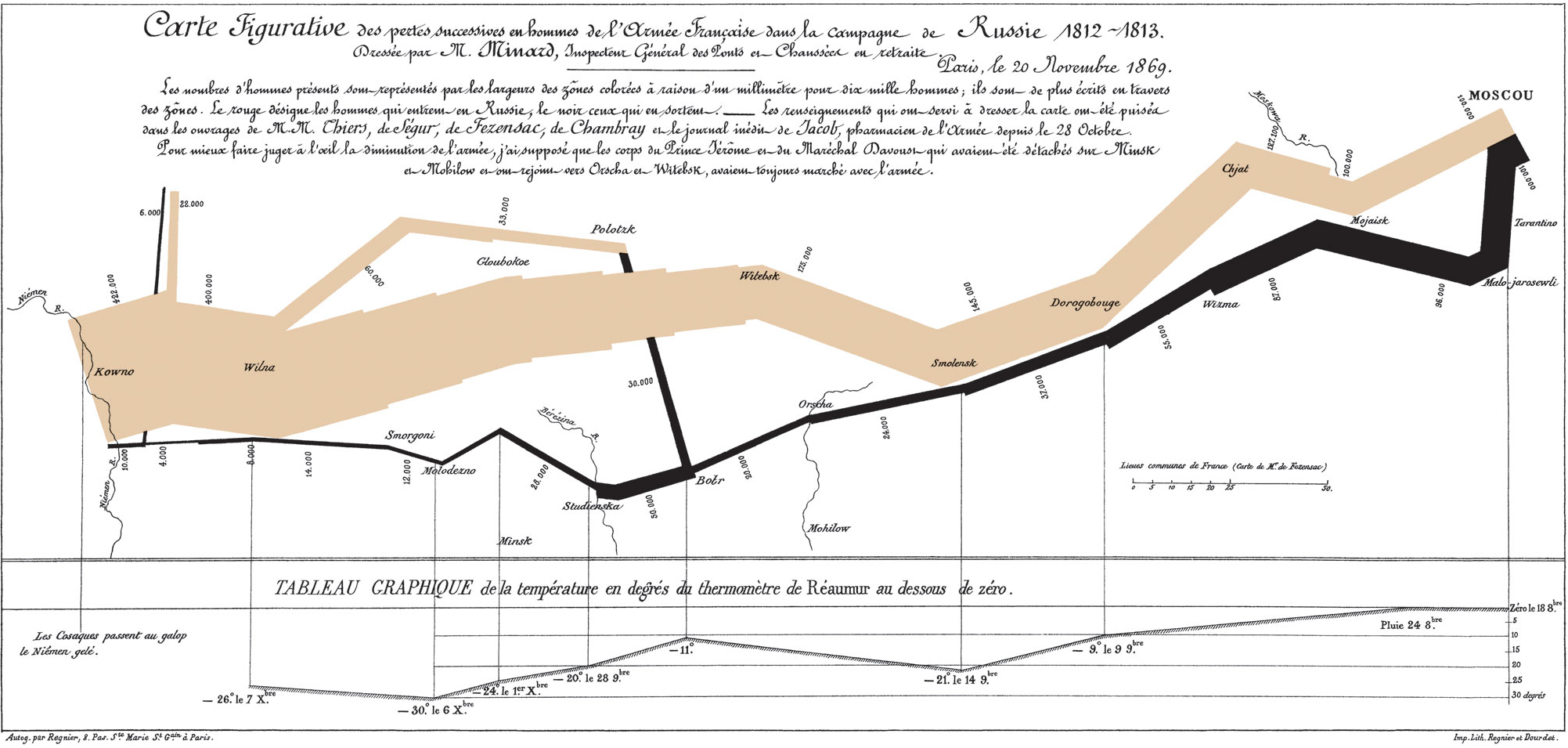
Charles Joseph Minard, a retired civil engineer, drew in 1869 the Carte figurative des pertes successives en hommes de l’Armée Française dans la campagne de Russie 1812–1813. Six variables (number of soldiers, direction of advance, temperature, latitude, longitude, time) encoded on a plane of two inks. Edward Tufte would put that plate on the cover of The Visual Display of Quantitative Information a century later with a simple argument: hierarchy is imposed by the data, not the decoration. Minard did not illustrate the campaign; he documented it, and that exhaustive documentation is what made it possible to see.
Massimo Vignelli and the National Park Service delivered the Unigrid in 1977: a single modular system that resolved, across several decades, hundreds of different brochures, one per national park. A black heading bar, a rigorous typographic grid, a three-value palette. They did not design a brochure; they designed the system that would allow hundreds of brochures to be designed without any of them feeling orphaned. Nearly fifty years later, the Unigrid is still alive. The system outlives the designer.
Edward Tufte formalised the principle in the data-ink ratio: every pixel that does not communicate data is noise. He did it with sparklines: charts so dense that they fit inside a sentence, with a single red mark on what matters. One single red. One single point. Everything else contained in the hierarchy of grey.
Ferran Adrià and his team produced, between 1987 and 2011, an exhaustive catalogue raisonné of their work: 1,846 pieces documented with a single photographer (Francesc Guillamet), uniform black background, unique numbering, technical dissection per unit. The catalogue arrived before the closure of the project, not after. It was not an epitaph: it was the corpus that would allow the work to be extended without being copied. The operational synthesis of the method can be stated in one editorial sentence: without curated context, creativity is imitation; with curated context, creativity is extension. What that team did for their field is what the agentic design system is starting to do for ours.
If you do not know what you have already done, everything you make is inevitably similar to what someone else already made. Editorial gloss on the spirit of the catalogue raisonné. Not a textual attribution to Adrià.
Four masters, one single lesson. Before imagining, order. Before classifying, contextualise. Real innovation does not spring from the blank page; it springs from the exhaustive inventory that lets you see the gaps. Mendeleev discovered elements that did not yet exist because he first ordered the ones that did.

The moment
This manifesto is written in April 2026. It has been eighteen months
since LLM-based agents began writing, executing and composing
interfaces with growing autonomy. About a year and a half since the
Model Context Protocol
was published (Anthropic, November 2024), leaving reasonable companies
thinking about exposing their design system as context legible to
machines. Brad Frost has been writing about agentic design systems for
years on bradfrost.com, and in October 2025
the Design Tokens Community Group
published its first stable version,
on top of which this corpus proposes using the open $extensions
field to annotate policies ($extensions.policy); the exact
convention discussed here is the author’s editorial proposal, not a
ratified part of the standard.
The moment is peculiar. The design systems of large organisations, built with patient effort between 2015 and 2025, are good enough to serve human designers and developers. But they are often not good enough to be read by a machine that has not previously digested them. An LLM that tries to compose a view in our system invents. It invents variants, invents token names, invents libraries that do not exist. It is an already well-observed pattern in any team that has tried to connect an agent to their system. The problem is not the agent: it is the context we give it.
The Second State is born when we accept that asymmetry and resolve it. The Second State is the design system that becomes machine-governable: canonical tokens in OKLCH with policy metadata, components with contract tests that fail when the agent invents a prop, OPA validators that reject compositions outside norm, telemetry that measures which part of the system agents consume and which part humans consume. The design system stops being a library consumed by humans and becomes a library consumed also by machines, with full documentation about what they can and cannot do.
The Third State is the one that interests the author most in
2026, because it is the one that still does not exist in serious
production and where the editorial risk is greatest. In State 3,
the design system is plastic. Its components adopt distinct shapes
while maintaining their matter. A bilingual <Heading> mutates the
tracking when the reader is in Japanese, keeps the ligature when the
reader is in Spanish, and declares both mutations in the visible
DOM. A <DataTable> regenerates column density according to screen
size, pointer type, and the reader’s reading speed, and it documents
each mutation in an adjacent public log. A design system that
explains what it just did.
Why now
The classical design system (State 1) gets closer to the machine only when the person who maintains it forces themselves to document what was previously left implicit. There is no useful agent without prior exhaustive documentation. This is the same principle that Mendeleev applied in 1869 with chemical elements: ordering the known allows you to predict the unknown without inventing ghosts. The Compendium is the operational equivalent for a design system preparing to be consumed by machines: without ordered corpus, the agent hallucinates; with ordered corpus, the agent extends what exists.
The design system of the near future, the one teams are about to build, is that same Compendium. The agent is not the novelty. The novelty is the corpus. The agent is merely the reader the corpus deserves.
What this manifesto is not
It is not prophecy. The LLMs of 2028 will do things hard to imagine in 2026 and will make errors that today seem solved. It is not a vibe coding gospel. It does not celebrate generation without context. On the contrary: it celebrates extreme rigour, literally extreme, as a sine qua non condition for generation to have value.
Nor is it a critique of the classical design system. State 1 remains, in my estimation, the bulk of real work for most teams, and will remain so for years to come; this is a field observation, not a survey figure. State 2 does not replace State 1; it enables it for a new class of readers. State 3 does not replace State 2; it demonstrates what is possible when policies are written.
Nor does this aim to be a solo declaration. Design systems are built among many; the method, too. Each time a person in the field (author, practitioner, researcher) accepts being cited or contributes a documented correction, their name will appear in the colophon with the date of the conversation. Until then, no endorsements are enumerated that do not exist.
How to read this
Best read in this order:
- Read the three states (at /en/states/state-1, /en/states/state-2, /en/states/state-3). Twenty minutes.
- Read the colophon: there the editorial method, the agent deontology, and the licence are declared.
- Explore the Compendium: the navigable catalogue with the first component fiches (only available in Spanish in this phase; the English translation arrives with phase 2).
The presentation of a work changes over time because the world changes; its internal logic stays. This manifesto is the logic. Everything else is presentation that will be refined with each public revision.